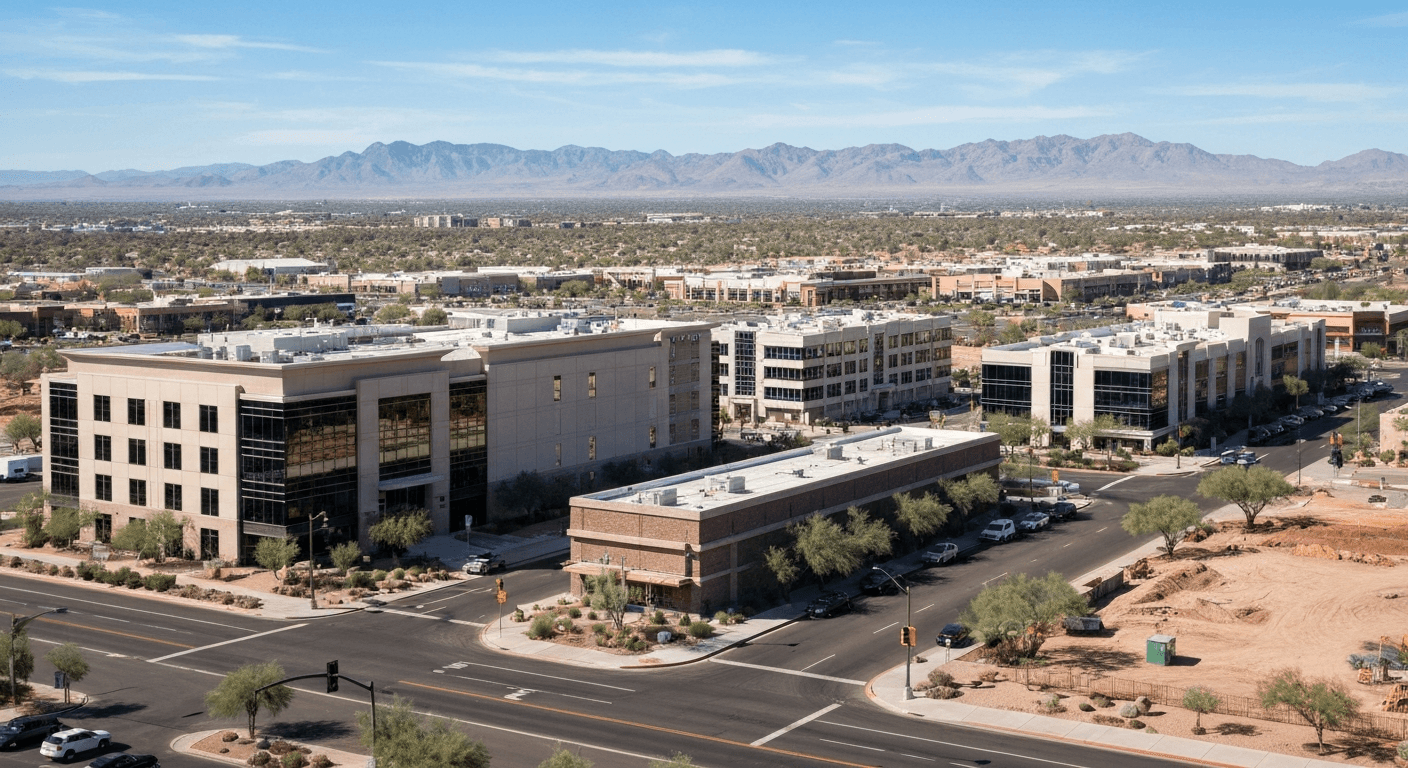
The Colorado River is over-allocated on paper and short in the ground, and after two years of failed state negotiations the Bureau of Reclamation put a hard number on it: on July 31, 2026 the agency's final environmental impact statement proposed cutting Lower Basin use by 3 million acre-feet a year, which the Arizona Department of Water Resources calculates would erase about 77% of Arizona's legal allocation (Arizona Capitol Times, July 31, 2026). We build industrial in metro Phoenix, so we read that not as an environmental story but as an entitlement story. Water is becoming one of the gates a project has to clear, and the size of that gate depends on what your tenant does with the space.
This piece is the plumbing behind that: who actually uses the river, what an acre-foot is, and why a car wash, a warehouse, and a chip fab are three completely different water bets on the same dirt.
What an acre-foot is
Water rights are measured in acre-feet. One acre-foot is the water it takes to cover one acre one foot deep, which is 325,851 gallons. A common rule of thumb is that an acre-foot serves two to three average households for a year. Everything below is quoted in acre-feet because that is the unit the compacts, the courts, and the cuts are written in.
Who uses the river
The river supplies about 40 million people across a 250,000 square mile basin (EESI; ScienceInsights). The 1922 Colorado River Compact and the 1944 treaty with Mexico divided it into 7.5 million acre-feet a year for the Upper Basin (Colorado, Wyoming, Utah, New Mexico), 7.5 million for the Lower Basin (Arizona, Nevada, California), and 1.5 million for Mexico, so 16.5 million acre-feet were promised (Grand Canyon Trust). The river has not delivered that. From 2000 to 2023 actual flows averaged roughly 12.5 million acre-feet a year (NASA Science). The gap between 16.5 promised and 12.5 delivered is the entire dispute.
The headline most people miss is that cities are not the big user. Agriculture consumes more than 60% of the basin's water, and inside Arizona farming accounts for over 70% of total state water use (American Farmland Trust; Arizona Department of Water Resources). Half the river is diverted to irrigate about 5 million acres of farmland that grow roughly 15% of U.S. agricultural output (American Farmland Trust). Real estate, all of it, residential and commercial combined, is fighting over the minority slice that is left after the fields are watered.
Arizona's position, and why it takes the first hit
Arizona is entitled to 2.8 million acre-feet a year, and the Colorado River supplies about 36% of the state's total water (Arizona Department of Water Resources). The catch is priority. Arizona agreed decades ago that its Central Arizona Project (CAP), the canal that carries river water to Phoenix and Tucson and delivers about 1.5 million acre-feet, sits junior to California in a shortage. So Arizona absorbs cuts first, and within Arizona the CAP priority system pushes those cuts onto agriculture before cities.
That is already happening. Under the Tier 1 shortage in effect for 2025, Arizona left 512,000 acre-feet in Lake Mead, which the Central Arizona Project describes as about 30% of its normal supply (Central Arizona Project). Pinal County farmers have already lost most of their river water, a point Representative Teresa Martinez raised in the pushback on the federal plan (Arizona Capitol Times).
The recent federal and state fight
Two sets of rules expire at the end of 2026: the 2007 Interim Guidelines that govern Lower Basin shortages and coordinate Lake Powell and Lake Mead, and the 2019 Drought Contingency Plans (Bureau of Reclamation; Nevada Current). The seven states were supposed to write the replacement. They did not. The core disagreement is who cuts: the Lower Basin wants all seven states to share mandatory reductions in dry years, and the Upper Basin, which already uses less and faces no mandatory cuts today, refuses (Nevada Current, November 2025). States blew past the November 11, 2025 deadline, and the federal government stepped into the vacuum.
The two numbers on the table now show the spread. In May 2026 the three Lower Basin states (Arizona, California, Nevada) jointly proposed a 1.25 million acre-foot annual cut, which would reduce Arizona's supply by about 31%. Reclamation's July 31, 2026 preferred federal alternative instead calls for a 3 million acre-foot cut, the roughly 77% figure. Governor Katie Hobbs urged the federal government to adopt the states' compromise for 2027 and 2028, and the Arizona Department of Water Resources warned the federal number would devastate the state's water users and economy (Arizona Capitol Times, July 31, 2026).
Why this lands on a lease
Here is where it stops being a policy story. A building does not use water. Its tenant does, and tenants differ by one to two orders of magnitude in how much they need. That difference is now the thing that decides whether a project clears its water approvals, especially in Arizona, where new development has to show an assured water supply and several cities have started capping industrial demand outright.
Retail
Inside a single retail center the range is enormous. A grocery anchor, a sit-down restaurant pad, a car wash, and a laundromat are heavy water users, both in consumption and in the sewer and grease capacity they require. An apparel store, a nail salon, or a phone repair shop use almost nothing beyond a restroom. When we underwrite a center, the water-intensive pads are usually the hardest to permit and the most expensive to plumb, and a car wash or a quick-service restaurant will often need a dedicated water and sewer study before the city signs off. The tenant mix is a water plan whether or not anyone calls it that.
Industrial, and why the label matters
"Industrial" now covers two opposite water profiles, and conflating them is a mistake.
A logistics box or a small-bay or shallow-bay building, the product we develop, is a low-water use. The demand is domestic (restrooms), landscape irrigation, and a fire-suppression tank. Per square foot it is one of the least thirsty things you can build, which is part of why cities keep approving it.
At the other end, water-cooled data centers and semiconductor fabs are among the most water-intensive uses in the region. Individual data centers run anywhere from 50,000 to 5 million gallons a day (independent estimates cited by Grist). A Ceres analysis put Phoenix-area data center use at about 385 million gallons in 2024 and projected it could grow roughly tenfold to about 3.8 billion gallons a year (Grist; Phoenix New Times). TSMC's north Phoenix complex currently uses about as much water as 10,000 homes, though the company plans reclamation plants to recycle 90% of its cooling water (Grist).
Cities have responded by capping the thirsty end, not industrial in general. Chandler limits data center water use to 115 gallons a day per 1,000 square feet, and Marana prohibits data centers from using potable water at all (Phoenix New Times). Mesa, Phoenix, and Avondale have passed ordinances capping large industrial users and requiring developers to buy supplemental supplies to exceed the cap. In Mesa, large water users have provided roughly 7,800 acre-feet of additional supply, and in Buckeye a developer agreed to purchase supplemental Colorado River water to offset its groundwater draw (Grist).
The operator takeaway is that the same zoning can carry a tenant a city will fast-track or a tenant that triggers a supplemental-water requirement and months of review. A tenant's process-water demand is now part of the land's developability, not a detail you sort out after closing.
What we watch
Water is moving from a background assumption to a line in the pro forma, right next to power. For low-water industrial it is close to a tailwind: cities under a shrinking river would rather approve a warehouse that sips than a fab that gulps, and that preference shows up as faster entitlements. For anything water-heavy, retail pads included, the question before basis or rent is whether the city will commit the water at all. When the answer is no, the deal ends before the spreadsheet opens.
Sources
- Arizona Capitol Times, "Arizona facing deep Colorado River cuts under 'unacceptable' federal plan," July 31, 2026.
- Bureau of Reclamation, Colorado River Post-2026 Operations, and Alternatives Report for Post-2026 Operational Guidelines.
- Nevada Current, "With Upper, Lower basin states still snagged, feds give them more time to craft Colorado River plan," November 12, 2025.
- Grand Canyon Trust, "How Is Colorado River Water Divided?"
- NASA Science, "Meat of the Matter: Colorado River Over-Consumed."
- American Farmland Trust, "Colorado River Challenges Pose Risks to Western Agriculture."
- Arizona Department of Water Resources, Colorado River statements and shortage guidance.
- Central Arizona Project, "Colorado River Shortage" and Colorado River operations pages.
- Grist, "Arizona's water is drying up. That won't stop its data center rush."
- Phoenix New Times, "Phoenix data center water use set to surge nearly tenfold, study says" (citing Ceres analysis).
- Environmental and Energy Study Institute (EESI), "The Colorado River" briefing.
Frequently Asked Questions
- What is an acre-foot of water?
- An acre-foot is the volume of water needed to cover one acre to a depth of one foot, which equals 325,851 gallons. A common rule of thumb is that one acre-foot serves two to three average households for a year. Colorado River allocations and cuts are all measured in acre-feet.
- Who uses most of the Colorado River's water?
- Agriculture does. Farming consumes more than 60% of the basin's water and over 70% of Arizona's total water use, irrigating about 5 million acres. Cities and all commercial real estate together compete for the minority share left after irrigation, according to the American Farmland Trust and Arizona Department of Water Resources.
- What did the federal government propose for the Colorado River in 2026?
- On July 31, 2026 the Bureau of Reclamation's final environmental impact statement proposed a 3 million acre-foot annual cut to Lower Basin use, which Arizona says would erase about 77% of its 2.8 million acre-foot allocation. The three Lower Basin states had offered a smaller 1.25 million acre-foot cut in May 2026 (Arizona Capitol Times).
- Why does a tenant's water use affect a commercial real estate deal?
- Because a building's water demand comes from its tenant, and tenants differ enormously. In Arizona, new development must show an assured water supply, and cities like Chandler, Marana, Mesa, and Phoenix now cap or restrict water-heavy uses such as data centers. A thirsty tenant can trigger supplemental-water requirements or block approval entirely.
- Is industrial development good or bad for water in the Southwest?
- It depends on the type. Logistics, small-bay, and shallow-bay buildings use very little water (restrooms, landscaping, fire suppression) and are among the least thirsty uses to develop. Water-cooled data centers and semiconductor fabs are the opposite, using 50,000 to 5 million gallons a day, which is why several Arizona cities cap them specifically.