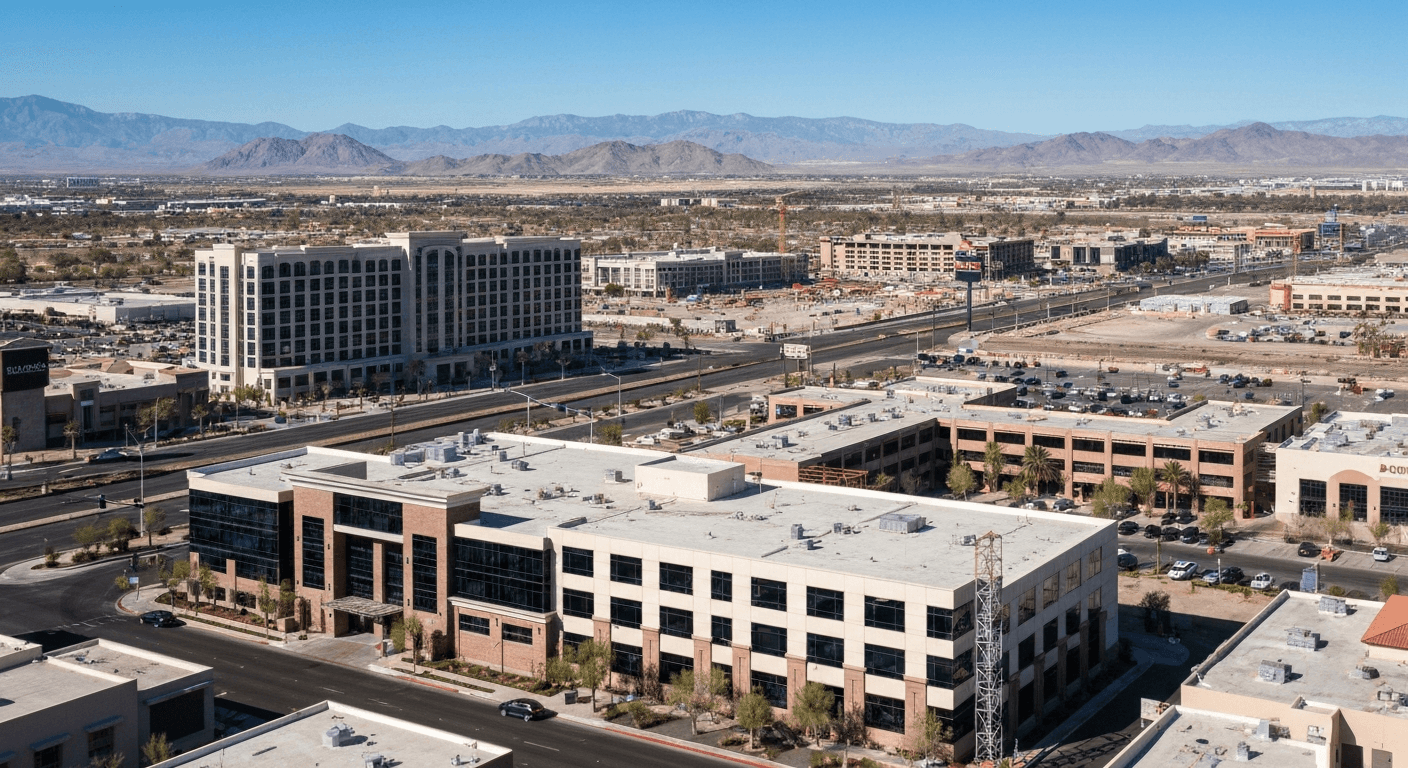
Our Backyard
Las Vegas industrial spent two years digesting a record construction binge. The Q1 2026 numbers say the digestion is nearly done. CBRE puts net absorption at 1.7 million square feet, the second straight quarter of falling vacancy, with the overall rate down to 8.8%. Only about 530,000 square feet delivered in the quarter, and 22% of that was preleased on arrival. Space under construction now stands at 6.8 million square feet, a fraction of the pipeline that loomed over the valley in 2023.
We read this as a market that has stopped fighting its own supply. When tenants absorb more than three times what builders deliver, landlords stop writing concessions and start testing rent again. The risk in Las Vegas industrial is no longer empty buildings. It is land.
The newest bidder for Southwest industrial land does not stock pallets. It racks servers. At the Tahoe Reno Industrial Center east of Reno, Tract broke ground on the Peru Shelf Technology Park, 686 acres designed to support up to 810 megawatts of utility capacity at full build-out, with initial power expected in late 2026 or early 2027 (Data Center Dynamics). Cushman and Wakefield now ranks Reno fourth among emerging data center markets in the Americas, and hyperscalers including Apple, Google, Microsoft, and Switch have operated at the same industrial park for years.
Here is why that matters to anyone underwriting a warehouse in Nevada or Arizona. Data centers want the exact inputs industrial development needs: flat, entitled, industrial-zoned land, plus power and water. They pay more per acre and they lock up grid capacity for decades. In Northern Nevada the contest is already visible. As it migrates south toward Las Vegas and the Phoenix exurbs, the cost of power and shovel-ready land becomes the ceiling on new industrial supply, not the cost of capital. That is a quiet tailwind for owners of existing, powered, infill product, which is most of what we like to own.
Asset Classes
The national apartment market crossed a line in Q1 2026 that it had not crossed in a year: tenants leased more than builders finished. CBRE reports 78,100 units of net absorption against 58,100 units delivered, with completions down 30% year over year. National vacancy fell 20 basis points to 4.8%, now below its long-run average of 5.0%. On paper, that is a market back in balance.
Rents have not gotten the memo. Average monthly rent rose all of 0.2% year over year, to $2,217 (CBRE). The gap between a tightening vacancy figure and a flat rent figure is the whole story of this cycle: demand is real, but in the markets that built the most, operators are still buying occupancy with free rent before they can push price.
Phoenix is the clearest example in our own footprint. Vacancy sits at 11.8%, more than double the national figure, and average asking rent fell 3% year over year to $1,535 (Kidder Mathews). The relief is in the pipeline, not the present: deliveries dropped 28% year over year to 2,978 units in the quarter, units under construction fell 30% to 16,399, and quarterly net absorption of 4,496 units ran well ahead of completions. The supply is finally turning off; the slack it left behind has not yet drained.
Our takeaway for high-supply Sun Belt multifamily: the recovery is a 2027 event, not a 2026 one. The vacancy already built has to burn off before rents move, and the operators who come through the concession war intact will be the ones who underwrote flat rents and a long runway rather than a quick snapback. We would rather buy into the back half of that curve than the front.
Sources
- CBRE, Las Vegas Industrial Figures Q1 2026
- CBRE, U.S. Multifamily Market (Q1 2026 figures and press release)
- Kidder Mathews, Phoenix Multifamily Market Report Q1 2026
- Data Center Dynamics, Tract Peru Shelf data center park, Reno
- Cushman and Wakefield, 2025 Global Data Center Market Comparison
Frequently Asked Questions
- Is the Las Vegas industrial market recovering?
- Q1 2026 marked a second consecutive quarter of falling vacancy, down to 8.8%, with 1.7 million SF absorbed against just 530,000 SF delivered and a pipeline shrunk to 6.8 million SF (CBRE). Supply discipline is restoring balance.
- How do data centers affect Southwest industrial real estate?
- They compete for the same flat, powered, industrial-zoned land that warehouses need, pay more per acre, and lock up grid capacity for decades. That makes power and entitled land, not capital, the binding constraint on new industrial supply.
- Has the multifamily supply wave peaked?
- Yes. Q1 2026 was the first quarter in a year where national net absorption (78,100 units) topped deliveries (58,100 units, down 30% YoY), and vacancy fell to 4.8%, below its long-run average (CBRE).
- Why are rents flat if vacancy is falling?
- In markets that built the most, operators are still buying occupancy with free rent, so vacancy improves before face rents do. National average rent rose just 0.2% year over year to $2,217 in Q1 2026 (CBRE).
- When does Phoenix multifamily recover?
- Likely 2027. Vacancy is 11.8% and asking rent is down 3% YoY, but the pipeline is draining fast (deliveries down 28%, units under construction down 30%), so existing vacancy has to burn off before rents move (Kidder Mathews).