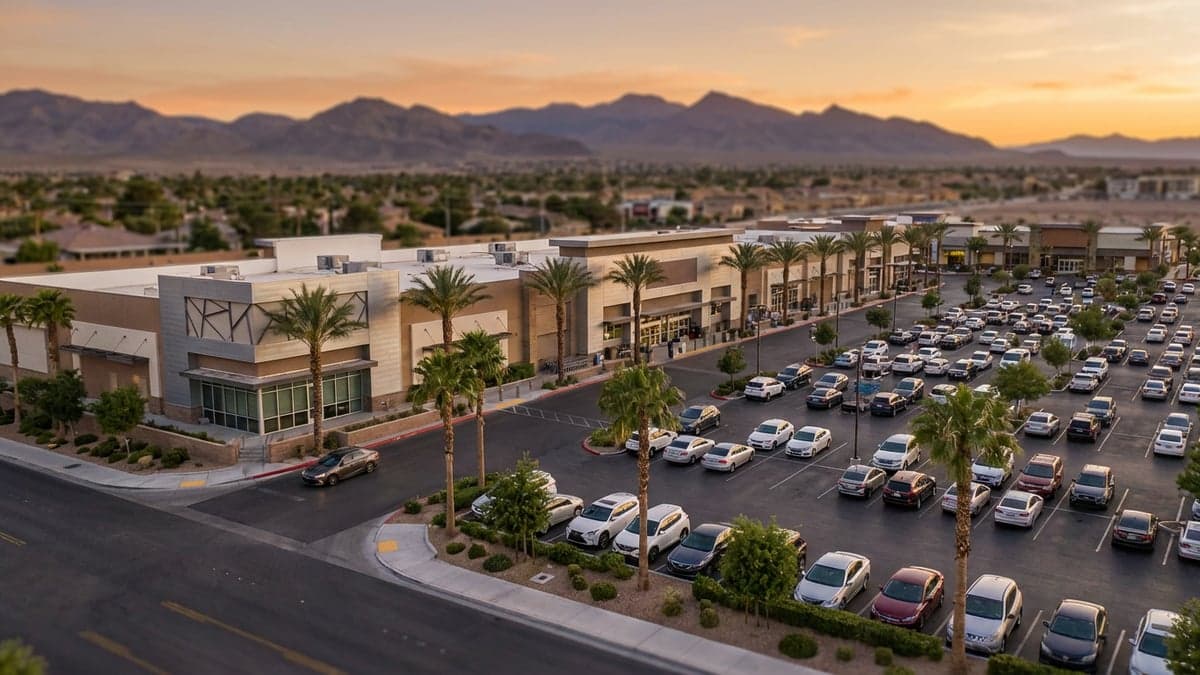
Southern Nevada retail just had its strongest three months in two years. In Q1 2026, the Valley absorbed 234,724 square feet of net new occupancy, more than the entirety of 2025 combined. Vacancy dropped to 4.3%. Weighted asking rent climbed to $1.96 NNN. A market that spent three years running in place finally took a step forward.
The averages hide a more interesting story about where demand landed, who signed the leases, and whether February's tourism rebound is signal or noise. The dashboards below let you dig into any of it.
Vacancy
4.3%
valley-wide
▼ -0.2 pts vs. Q4 2025
Net Absorption
235K SF
Q1 2026
▲ +155K SF vs. Q4 2025
Asking Rent (NNN)
$1.96
per SF, monthly
▲ +$0.06 vs. Q4 2025
Under Construction
569K SF
56.8% pre-leased
▲ +70K SF vs. Q4
The quarter in context
Colliers has tracked vacancy between 4.3% and 4.6% for three years running. That stability is notable. It persisted through 700 retail job losses, declining taxable retail sales, and relentless e-commerce pressure. The 20-basis-point move this quarter is not dramatic in isolation, but it's the first time the needle has pointed in the right direction since 2023.
Absorption tells the stronger story. The 235K SF gain reverses a first quarter of 2025 that actually shed 105K SF. Toggle the chart below to see how rent and absorption behaved through the year.
Five-quarter trend
Southern Nevada retail · Colliers data
The absorption pattern matters because it's happening with modest new supply. Only 89,590 SF delivered in Q1, one project, all in the Southwest. The pipeline under construction sits at 568,847 SF, and 56.8% of it is already pre-leased. The product being built isn't speculative. It has tenants before foundations pour.
The submarket divergence
Valley-wide vacancy is an average. Underneath it sits a six-percentage-point spread. The Southwest runs at 2.7%, effectively full. University East sits at 8.2%. Click any submarket on the map below to see its vacancy, rent, absorption, and construction pipeline.
Valley submarkets
Click any submarket on the map. Shading shows Q1 2026 vacancy (darker means tighter).
Select a submarket
Click any shaded area on the map to see vacancy, rent, absorption, and construction detail.
Submarket polygons are approximate. Each brokerage draws them slightly differently; these mirror the general directional groupings used in the Colliers report. The map data is Google, the shading and analysis are ours.
The Southwest drove absorption (116K SF, essentially half the Valley's entire gain), followed by Henderson (84K SF) and North Las Vegas (57K SF). These are the submarkets where household formation, rooftop growth, and income gains are concentrated. Downtown and Northwest gave back space.
The Southwest's rent, $2.63 NNN, is 34% above the Valley average. When vacancy is functionally zero in the best submarket, landlords have pricing power. Put all eight submarkets on the same chart and the pattern is clear:
Submarket comparison
The four quadrants: tight + expensive (top left) is the landlord’s market. Loose + cheap (bottom right) is the discount bin. Bubble size = inventory. Orange bubbles had positive Q1 absorption, gray bubbles lost tenants.
Ranked by metric
Same eight submarkets, one metric at a time. Toggle to re-sort.
By retail subtype
Not all retail moved the same way. Neighborhood centers, the grocery plus drug store anchored daily-needs format, absorbed 163K SF in a single quarter. That's an outsized result, and it reflects exactly the recession-resistant tenant base that defines our thesis. Strip centers, the unanchored inline product, went the other way.
By retail subtype
Click a bar to see definition and Q1 2026 performance.
Power Center
PCDominated by discount department stores, off-price stores, warehouse clubs, or 'category killers'. Little inline space.
- Vacancy
- 3.6%(0.0 QoQ)
- Net Abs (Q1)
- -2K SF
- Asking (NNN)
- $2.64
The power center read is worth flagging: 10.3M SF of inventory, vacancy steady at 3.6%, rents at $2.64 (the highest subtype rent in the Valley). Power centers aren't growing (they shed 1,600 SF on net), but they aren't leaking either. The big-box anchors signed in 2021 and 2022 are holding.
Who's actually leasing
The most important structural change in the Q1 data isn't in the vacancy column. It's in who's signing leases. Over the past four quarters, local businesses took 53.4% of tracked leasing activity.
Who took space
Share of leasing activity by tenant type · past 4 quarters
Where they came from
Tenant origin region · past 4 quarters
Locals took the majority of leased space. That’s the story of Q1.
This is a meaningful shift. Historically, national and regional chains drive a bigger share of take-up in sunbelt growth markets. The fact that locals are now the majority is partly a positive (Las Vegas entrepreneurship is real) and partly a reason 2025 net absorption was so sluggish. Local operators don't sign 10,000 SF leases the way a Ross or a Ulta does. It takes three or four local deals to replace one national.
On lease economics, the negotiation envelope tightened modestly. Scheduled rent bumps averaged 2.8% annually (down 30 basis points from the prior period). Free rent dropped to 2.0% of lease term. TI allowances appeared on 12.9% of deals. Read that as landlords getting slightly more conservative while the market firms up underneath them.
The tourism read
Retail in Las Vegas is always half real estate, half tourism. Foot traffic at the Strip and the locals-adjacent submarkets moves with visitor volume, convention attendance, and gaming revenue. The LVCVA's latest data tells a bifurcated story.
Foot-Traffic Layer
LVCVA tourism indicators
LVCVA Research · Feb 2026 report
Feb Visitors
3.03M
+2.1% YoY
Hotel Occupancy
81.7%
+1.2 pts YoY
ADR
$193
+3.8% YoY
RevPAR
$158
+5.3% YoY
YTD Visitors
6.30M
-0.2% YoY
YTD Gaming Rev (Strip)
$1.44B
-5.7% YoY
January ran cold (YTD visitors -0.2%, Strip gaming revenue -5.7%), but February rebounded hard, with the strongest RevPAR growth in months. The retail market’s Q1 jump aligns more with the February surge than the weak January.
January was weak across the board. February delivered some of the strongest RevPAR growth the market has seen in months, with hotel occupancy up 1.2 percentage points and ADR up 3.8%. The retail absorption jump lines up with the February recovery, not the January slump. Whether March held that pace determines if Q2 is a real continuation or a mean-reversion.
Investment sales
Capital markets signaled the same cautious optimism. Single-tenant investment volume in Q1 2026 reached $49.5M across 14 transactions, a slight dip from Q4 2025. The average price per square foot was the highest in six quarters. Cap rates compressed 20 basis points year-over-year to 5.1%. Fewer deals, but strong bids on the ones that closed.
Shopping center volume was $57.8M across 9 transactions at a 6.6% average cap rate. That's a step up from Q4's $42.6M. Both subsegments remain dramatically below the 2022 peak, when shopping center volume crossed $1B. The path back isn't to 2022. It's to a new equilibrium where a 100 to 150 basis point positive spread over the 10-year Treasury motivates transactions again.
Our read
Southern Nevada retail is moving from recovery to growth. It's not the 2021 and 2022 boom, and we're not arguing that it should be. The data supports a measured bullish case:
- Product scarcity is real in the submarkets where people actually want to be. Southwest at 2.7% vacancy with $2.63 rents and zero under construction is a landlord's market.
- The pipeline is disciplined. 569K SF under construction across a 70.7M SF market is not overbuilt, and 57% of it is already pre-leased.
- Local demand is sustainable but patient. Landlords underwriting to local tenant credit need longer lease-up timelines and more granular portfolio risk management. That's our sweet spot.
- Tourism is the swing factor. February's rebound is encouraging. A weak March would reset expectations for Q2.
For investors, the Q1 2026 data validates a focus on well-located neighborhood and community centers in the Valley's growth submarkets: Southwest, Henderson, North Las Vegas. The returns won't come from rent spikes. They'll come from owning real estate where tenants want to be, at pricing that reflects sustainable income.
Sources
- Colliers International: Q1 2026 Las Vegas Retail Market Report2026-04
- LVCVA Research: Executive Summary of Tourism Indicators, February 20262026-03
- Macro context from Nevada DETR employment data and the Clark County Department of Taxation, as cited within the Colliers report.
All charts on this page use our own visualizations built from the underlying data in the reports above. The Colliers and LVCVA reports are linked so you can read the originals.
Frequently Asked Questions
- How did Las Vegas retail absorption perform in Q1 2026?
- The Valley absorbed 234,724 SF of net new occupancy in Q1 2026, more than the entirety of 2025 combined. Vacancy fell to 4.3% and weighted asking rent reached $1.96 NNN. The Southwest drove roughly half of all absorption at 116,000 SF, followed by Henderson at 84,000 SF and North Las Vegas at 57,000 SF.
- Which Las Vegas retail submarkets are performing best in 2026?
- The Southwest leads with 2.7% vacancy and $2.63 NNN rents, effectively fully leased for modern contiguous space. Henderson and North Las Vegas also drove positive absorption. University East had the highest vacancy at 8.2%.
- What is driving Las Vegas retail leasing demand in Q1 2026?
- Neighborhood centers anchored by grocery and drug stores absorbed 163,000 SF in the quarter, the strongest subtype result. Local businesses took 53.4% of tracked leasing activity over the past four quarters, compared to the national and regional chain share typical of sunbelt markets.
- What did the Q1 2026 Las Vegas retail investment sales market look like?
- Single-tenant volume reached $49.5 million across 14 transactions. Shopping center volume was $57.8 million across 9 transactions at a 6.6% average cap rate. Cap rates compressed 20 basis points year-over-year to 5.1% on the single-tenant side.