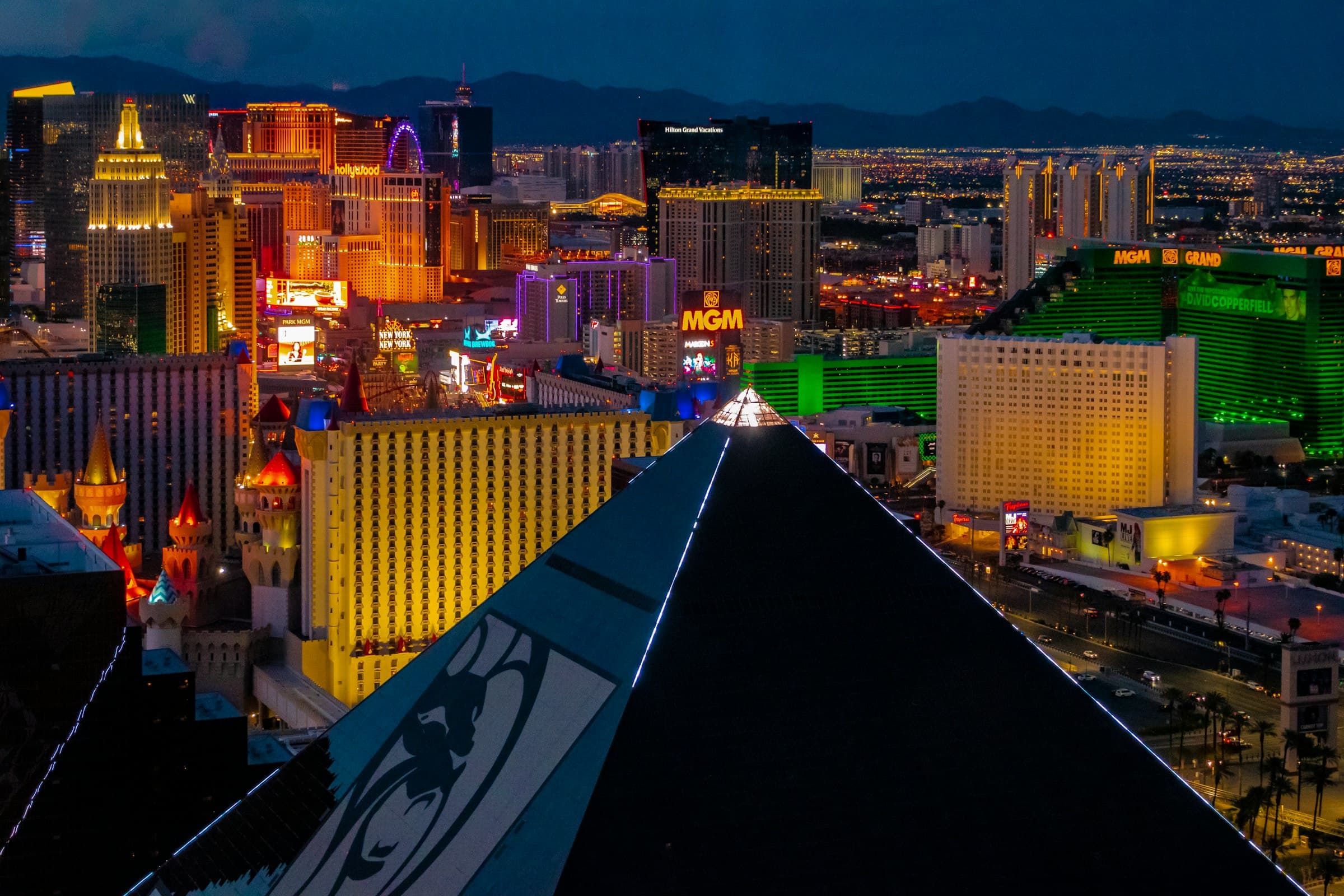
Two guys are about to own most of the Las Vegas Strip.
Tilman Fertitta agreed to buy Caesars last month for $17.6 billion. A few days later, Barry Diller bid $18 billion for MGM, a company he had already quietly built a 26% stake in. Put those two together and, if they both close, two private owners end up holding most of the major resorts on the Strip. Today those same resorts are spread across a dozen or so public companies.
The deals are the headline. But I build off the Strip, and they're not the only big change happening right now. The A's are putting up a stadium on the old Tropicana site, the NBA is on its way, and we're running out of room to build anything new.
I'll start at the Strip and work out to the deals I'd actually put money in.
Two private owners, most of the Strip
The Strip has spent most of the last few decades owned by public companies. Public companies report every quarter and have shareholders to keep happy, so they tend to sell when a property dips and think twice about anything that takes ten years to pay off.
Fertitta and Diller don't operate that way. They're using their own money and they're not in a rush. If both deals close, two people will control most of the best-located real estate in the city, and that gives them a lot of say over how everyone else does business. Say one of them raises the rent on the retail inside a resort. That number becomes the comp the next landlord down the street points to. Or one pushes a project back a year, and the subs they had booked start calling me looking for work. Their decisions set the price of labor and space across the whole valley, mine included.
What Fertitta is buying
Fertitta isn't really buying casinos. He's buying buildings, and he's taking on a pile of debt to do it. The deal has him absorbing roughly $12 billion of Caesars' existing debt and rolling the company into the hospitality business he already owns, which runs from Landry's to the Golden Nugget to a few hundred restaurants.
He has been trying to get bigger on the Strip for a long time. In a 2019 interview with the Review-Journal, he called himself "an opportunistic buyer" who would only move at the right price. It took years, but the deal he was waiting for turned out to be the entire company.
What Diller is doing
Diller is making a different kind of bet. His company, People Inc. (it used to be IAC), already owns about a quarter of MGM, and he thinks the stock is, in his words, "wildly undervalued." His logic is that the buildings themselves, the actual real estate on the Strip, are the part the market keeps getting wrong, because they're hard to copy and AI can't touch them. So he wants to take MGM private and sit on that real estate, with the company's online business and its piece of BetMGM coming along for the ride.
The sports piece
Two teams are coming within a couple of years of each other. The A's land first, in 2028, in a new stadium on the old Tropicana site. The NBA is right behind: the league voted in March to take a serious look at Las Vegas and Seattle, it's taking bids now, and it expects to award teams by the end of the year, with games starting in the 2028-29 season.
A team is a calendar.
The Raiders already proved it. Look at what a home game does to October room rates. But football is one game a week for a few months. Baseball is 81 home games, most of them on weeknights, all summer long, which happens to be the stretch when this town has always emptied out. Filling those Tuesday and Wednesday nights is the difference between a restaurant that limps through July and one that doesn't.
The NBA brings a different kind of visitor, younger and with more money, a lot of them from overseas. That crowd spends on high-end retail, and the team's most likely home, Oak View Group's proposed $10 billion development on the south end of the Strip, would pull the next wave of building in that direction.
Where the opportunity actually is
The Strip gets the attention. If you build for a living, the better deals are usually a few miles off it, in warehouses, strip centers, and small office buildings.
Hotels and gaming
When two owners control 80% of the Strip, they stop competing on room rates and start competing on everything else: the arena seats, the sportsbook lounge, the chef whose name is on the restaurant. Expect the older resorts to pour money into that stuff, and into the high-end retail that comes with it.
Retail in Henderson and Summerlin
The plain suburban strip mall has been in trouble for a while. What's leasing is the nicer, open-air kind of center out in Henderson, Green Valley, and Summerlin, the places where people actually have money. The visitors and the executives moving here want a version of the Strip closer to where they live. Some of the best deals I see are dead office parks and tired plazas, bought cheap and gutted and turned into restaurants, gyms, and the occasional medical tenant.
Small-bay industrial
This is the one I spend the most time on. Every show on the Strip runs on a supply chain you never see: the company that builds the stage, the one that runs the kitchens, the one that keeps the uniforms clean. The giant distribution warehouses are getting pushed out to the edge of the valley, but that close-in work has to stay close, and there's barely any land left to put it on.
That's why a small bay, somewhere between 1,500 and 5,000 square feet with a roll-up door, rents for more per foot than people expect. Put up a multi-tenant park in the right spot and you're selling the one thing nobody else has left: proximity.
Multifamily over single-family
Land is expensive and getting more so, and the valley keeps adding people, so building tilts away from single-family tract homes and toward density. All the stadium work, plus the permanent jobs that come with running these teams and companies, keeps apartments full. At the same time, high rates and high land prices have priced a lot of those same workers out of buying a house. So the nicer apartments and the build-to-rent communities pick up the executives, and the mid-rise projects closer in pick up the people who staff all of it.
Suburban and medical office
The big commodity office tower is still a mess. No surprise there. What's quietly working is smaller, nicer office out in the suburbs: the satellite office a consolidating company hangs onto, the wealth manager, the sports agency that wants to be near where the executives live instead of stuck in Strip traffic. Pair that with medical offices chasing the retirees in Henderson and Summerlin and there's a real business there.
My ten-year read
I think about this in two halves. The first five years are about absorbing everything that's getting built. The five after that are about running out of room. Here's roughly where I land on each piece. These are my numbers, not anybody's official forecast.
| Sector | Years 1-5 rent growth (2026-2031) | Years 5-10 rent growth (2031-2036) | Cap rates and land |
|---|---|---|---|
| Small-bay industrial | 5.5% to 7.0% a year (close-in land runs short) | 4.0% to 5.0% a year (valley fully built out) | Sub-5.0% caps, highest price per foot in the market |
| Lifestyle retail | 3.8% to 4.5% a year (suburban demand) | 3.2% to 4.0% a year (density takes over) | Compressed and stable, NNN yield premium |
| Class-A multifamily | 3.0% to 4.2% a year (pipeline fills) | 4.5% to 5.5% a year (buyers priced out of houses) | Structural compression, scarcity premium |
| Suburban office | 1.5% to 2.5% a year (medical and executive niche) | 1.0% to 2.0% a year (adaptive reuse) | Widening, dispersed portfolios under stress |
2026 to 2031
These are the building years. The crews on the stadium and the south-Strip project will keep labor tight and costs high. I'd expect apartments and small-bay industrial to lease up fast between about 2027 and 2029, while there's still dirt close to the action to build on.
2031 to 2036
Sometime in the early 2030s the valley hits a wall, and it's a literal one. Las Vegas is ringed by federal land, and there's only so much private dirt inside the BLM line before you run out. When you can't go out, you go up. Land gets more expensive, a new single-family house stops penciling for most buyers, and rents climb, which is where my 4.5% to 5.5% comes from. Even the industrial guys start stacking bays two and three stories high, the way they do in cities that ran out of room a long time ago.
The bottom line
Las Vegas is changing how it makes its money, and a lot of the action is moving off the Strip. I'm not chasing the deals that make the news. I'd rather own the boring real estate all of it runs on, bought cheap enough that it still works when the market turns.
If you want to talk about how we do that, here's how we work with investors, or you can submit a deal.
Sources
- Tilman Fertitta grows footprint on the Strip with Caesars buyout (Las Vegas Review-Journal)
- Barry Diller's People Inc. offers to buy MGM Resorts, valuing it at $18 billion (CBS News)
- Barry Diller's IAC to change name to "People Incorporated" (Variety)
- NBA Board of Governors approves exploration of expansion to Seattle, Las Vegas (NBA.com)
- Athletics' $2B Las Vegas stadium on track for 2028 opening (ESPN)
- Vegas basketball arena developer says $10B project is growing (The Nevada Independent)
- Tilman Fertitta talks about desire to own Las Vegas Strip property, 2019 (Las Vegas Review-Journal)
About the Author
Andrew Dunn is a Principal at VAC Development, a commercial real estate investment and operating firm focused on retail and industrial assets across the Southwest and Mountain West. VAC underwrites with basis discipline as its core thesis, acquiring and building below replacement cost in infill markets where supply is constrained and demand drivers are durable.
© 2026 VAC Development. All rights reserved. This article is for informational purposes only and does not constitute investment advice or an offer to sell securities. Forward-looking projections reflect VAC Development's analysis of current market conditions and are subject to change.
Frequently Asked Questions
- What do the Fertitta and Diller deals mean for Las Vegas real estate?
- If both deals close, two private owners would hold most of the major Strip resorts instead of the dozen-plus public companies that own them today. Private owners set pricing and pace projects on longer time horizons, and their decisions on labor and lease rates become the comps everyone else in the valley works from.
- How does the A's stadium and an incoming NBA team affect commercial real estate in Las Vegas?
- The A's bring 81 home games, most on weeknights in summer, filling the dates that historically went dead. The NBA adds a younger, higher-spending visitor base. Together they support restaurant, retail, and hospitality demand beyond what football alone provides.
- Why is small-bay industrial the strongest real estate opportunity in Las Vegas right now?
- Every show and event on the Strip runs on a local supply chain of staging, kitchen, and service companies that need to stay close to the action. Close-in land is nearly exhausted inside the BLM boundary, so small-bay industrial space (roughly 1,500 to 5,000 square feet with a roll-up door) commands a rent premium that larger distribution warehouses on the valley's edge do not.
- What are the projected rent growth rates for Las Vegas real estate over the next ten years?
- The article projects small-bay industrial at 5.5% to 7.0% a year through 2031 and 4.0% to 5.0% a year from 2031 to 2036. Class-A multifamily is projected at 3.0% to 4.2% a year in the first five years and 4.5% to 5.5% a year in the second five years as buyers are priced out of single-family homes. These are VAC Development's own projections, not official forecasts.
- Why is developable land running out in Las Vegas?
- Las Vegas is surrounded by federal BLM land, which caps the amount of private dirt available inside the valley. Once that supply is exhausted, new construction has to go vertical, land prices rise, and single-family homes stop penciling for most buyers.