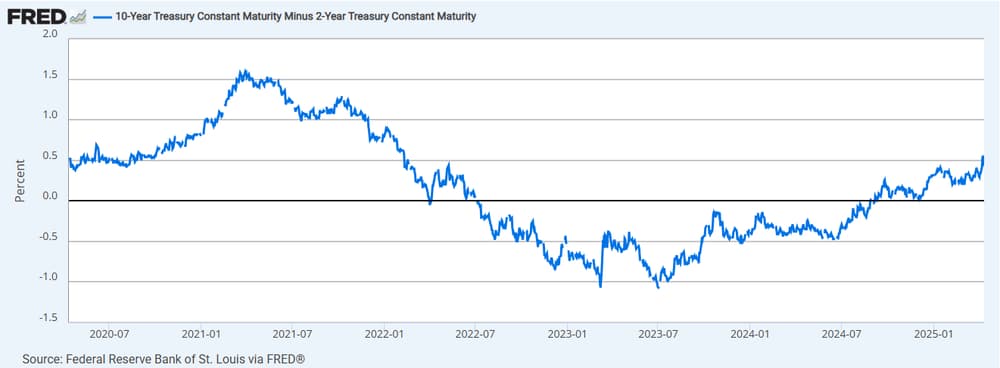
Around April 11, 2025, the US bond market was signaling economic uncertainty: a yield curve that had recently turned positive after a sustained inversion, investment-grade bonds outperforming high-yield debt, and a Federal Reserve holding rates steady while projecting cuts. For commercial real estate developers, those signals matter because they shape capital availability and investor appetite for new projects. Here is what the data was showing.
The US Economic Landscape: Navigating Uncertainty
The bond market in the US in the last couple of weeks painted a picture of increasing economic uncertainty, with several key indicators flashing caution signs.
1. The Tale of the Yield Curve
One of the most closely watched indicators is the US Treasury yield curve, which plots the yields of Treasury bonds across different maturities. Historically, an inverted yield curve (where short-term yields, like the 2-year, are higher than long-term yields, like the 10-year) has been a reliable predictor of economic recessions. While the curve had recently turned positive around April 2025 after a period of inversion, the preceding sustained inversion suggested that concerns about a potential economic slowdown remained prevalent. The market was essentially signaling that investors expected weaker economic growth in the future compared to the near term.
2. Corporate Bonds: A Flight to Safety?
The performance of corporate bonds, particularly the difference in yields between investment-grade and high-yield (or "junk") bonds, also offered insights. Around this time, investment-grade corporate bonds were outperforming high-yield bonds. This indicates a growing risk aversion among investors. When economic outlooks are uncertain, investors tend to favor safer assets with lower default risk, leading to higher demand and thus lower yields (and better performance) for investment-grade bonds compared to their riskier, high-yield counterparts. This suggests that the bond market was signaling a potential decrease in appetite for riskier ventures, which could impact development projects.
3. Inflation and the Fed's Response
Despite concerns about slowing growth, inflation remained a key issue. The Federal Reserve's cautious stance of holding interest rates steady, while projecting future rate cuts, reflected this complex environment. The bond market was likely factoring in these expectations and the ongoing battle to control inflation.
4. Stock Market Signals
Interestingly, around March 2025, US stocks underperformed international stocks. This underperformance, attributed to concerns about US economic growth, further corroborated the cautious signals emanating from the bond market.
Global Economic Ripples
The US bond market's movements had a noticeable impact on the global economic landscape.
1. Increased Global Volatility
The uncertainty and volatility in the US Treasury market led to increased volatility in bond markets worldwide. This interconnectedness highlights how developments in the US economy can quickly ripple across the globe.
2. Trade Tensions and Uncertainty
New tariffs announced by the US around this time added another layer of uncertainty to the global economic outlook. These trade tensions can disrupt supply chains, impact business confidence, and ultimately affect economic growth globally, all of which are reflected in bond market sentiment.
3. Regional Variations
While the US showed signs of slowing, some regions, like Europe, presented a more positive picture with expectations of increased fiscal spending potentially boosting their economies. This highlights the diverse economic conditions across different parts of the world.
Conclusion: Navigating the Economic Landscape
As of April 2025, the bond market was sending clear signals of economic uncertainty in the US, with potential implications for global growth. The inverted (and recently just positive) yield curve, the preference for investment-grade bonds, and the cautious stance of the Federal Reserve all pointed towards a period where careful monitoring of economic conditions is crucial.
For those in the commercial real estate and development sector, these signals suggest a need for careful planning and risk assessment. While underlying demand for well-located, functional assets may remain strong, broader economic uncertainties can influence investment decisions and capital availability. Keeping a close eye on these bond market indicators, alongside other economic data, will be vital for making informed decisions and navigating the evolving economic landscape.
Disclaimer: This analysis is based on bond market data and news around April 11, 2025, and should not be considered financial advice. Economic conditions are subject to change.
Frequently Asked Questions
- What was the US bond market signaling about the economy in April 2025?
- The bond market was signaling increasing economic uncertainty. The yield curve had recently turned positive after a sustained inversion, investment-grade bonds were outperforming high-yield bonds, and the Federal Reserve was holding rates steady while projecting future cuts. Together these pointed to expectations of weaker growth ahead.
- What does an inverted yield curve mean and why does it matter?
- An inverted yield curve means short-term Treasury yields are higher than long-term yields. Historically it has been a reliable predictor of economic recessions, because it reflects investor expectations of weaker growth in the future relative to the near term.
- What does the spread between investment-grade and high-yield bonds tell investors?
- When investment-grade bonds outperform high-yield bonds, it signals growing risk aversion. Investors are favoring lower-default-risk assets, which suggests they expect economic conditions to deteriorate and are pulling back from riskier bets.
- How should commercial real estate developers interpret bond market signals?
- Bond market signals like a flattening yield curve, widening credit spreads, and rising volatility suggest reduced capital availability and lower investor appetite for speculative projects. The article recommends careful planning and risk assessment during such periods, while noting that well-located, functional assets may still see durable underlying demand.